Chapter 3: Competitor Research
Did you create your categories of competitors?
Now it’s time for us to fill out the following categories for each competitor:
Features/Products/Services
Pricing
Target Audience
Marketing
Differentiators
Ethos driving their brand
Strengths
Weaknesses
Let’s dig into the first four categories.
Expand each item below to view a research checklist for you to complete.

-
What products do they offer?
What products are they pushing the most?
Go Incognito + type brand name into Google. Look at “Sponsored” results and record which products they’re pushing.
Are there products or features they have that you don’t? Where’s the difference?
How do they distribute their products/services/features?
Any notable strategies such as free trials, satisfaction guarantees, etc.?
-
What is the general range of cost for their products? Has there been any price variance over time?
Is there a pricing model? (subscription based, one-time, tiers, monthly/annual, discounts)
Which platforms do they sell on? Is there any cost variance?
How do they stack up against other competitors in terms of cost?
Is there any online sentiment available on how their audience feels about price? Affordable/fair/cheap? (i.e. Shein people boast about how incredibly affordable they are)
How do they approach shipping?
-
Who primarily follows them on social?
Who is primary leaving reviews?
Are there influencers working for this company? If yes, what is that influencers niche and target audience?
What appears to be their target audience’s primary pain point? (i.e. what is their product/service/feature solving)
How engaged is their audience? What channels does their audience appear to be the most engaged in?
-
What promotion strategies do they use? (influencers, ads, blogs, social media, billboards, etc.)
Do they have a website? An Etsy shop? A different marketplace?
Do they have a blog? How frequently is it updated?
Do they have premium type content such as ebooks or whitepapers? Are these form gated, not form gated, a cost? Are they posted on their website or elsewhere?
Do they offer other types of content such as podcasts, webinars, case studies, FAQs?
Do they have any presence with the press? (press releases, earned media backlinks) - googling their name, most likely you’d see any major publication mentions
Can you shop in-store or only online?
Do they have an email newsletter? How frequently is it sent?
Which marketing channels drive the most traffic?
Competitive Differentiators.
You’re going to fill in the following template (I found in a Reddit article awhile back and LOVE using this):
“<a competitor> is confident that customers will buy <a competetitor>’s product because <a competitor> solves <a customer problem> better than any alternative due to the following reasons:
Proof 1: (e.g. cost advantage, location and so on)
Proof 2: …
Here’s an example:
Amazon Prime makes it unbelievably easy to purchase something. Amazon Prime is confident that customers will buy on their platform because Amazon Prime makes purchasing quick and more frictionless than any alternative due to the following reasons:
Warehouses stocked in nearly every city to allow most purchases to be delivered within 1-3 days
The ability for people to set up an account and list their products on Amazon, so you can get a product faster through Amazon than you could through a brands website
Amazon Prime is set at a manageable annual cost and includes more than just shipping benefits — there’s a TV subscription, music subscription, among other things.
Tip: Googling “[brand name] core values” and reviewing what their company values are will typically help you get the wheels turning when trying to discover a competitors differentiators.
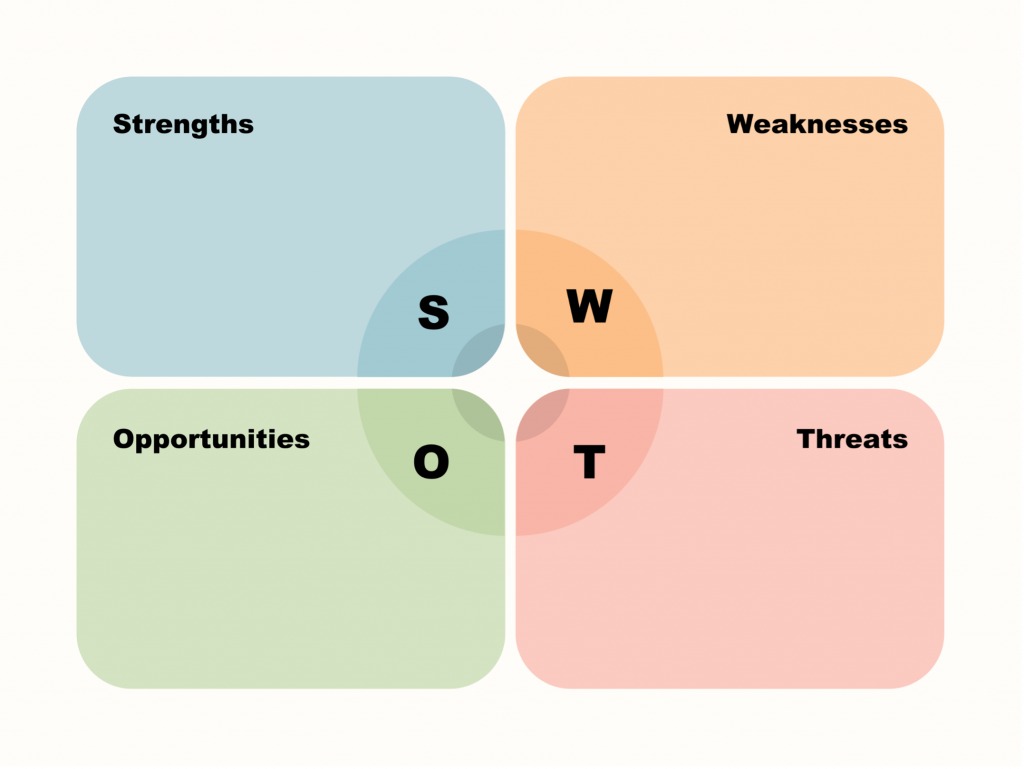
SWOT Analysis
Armed with all of this information, it’s time to create a SWOT analysis for each of your competitors. Based on all of the information you’ve compiled, you’ll want to identify:
Strengths: this is likely their positive differentiators
Weaknesses: this is likely going to be any negative reviews they receive or if you had any bad user experience on their site
Opportunities: any emerging trends you see competitors could capitalize on. For example, if they aren’t using AI yet, do you think they could in the future?
Threats: For example, a looming recession could shut down a business. An election year could create a volatile online environment. If they are a highly regulated industry, rapid compliance changes could be a threat.